The State-by-State Tobacco Tax Compliance Crisis
If you sell tobacco or nicotine products in multiple states, your compliance burden just got significantly worse. The tobacco tax landscape in 2026 is a patchwork of overlapping requirements that no manual process can reliably manage — and nicotine pouches just made it exponentially more complex.
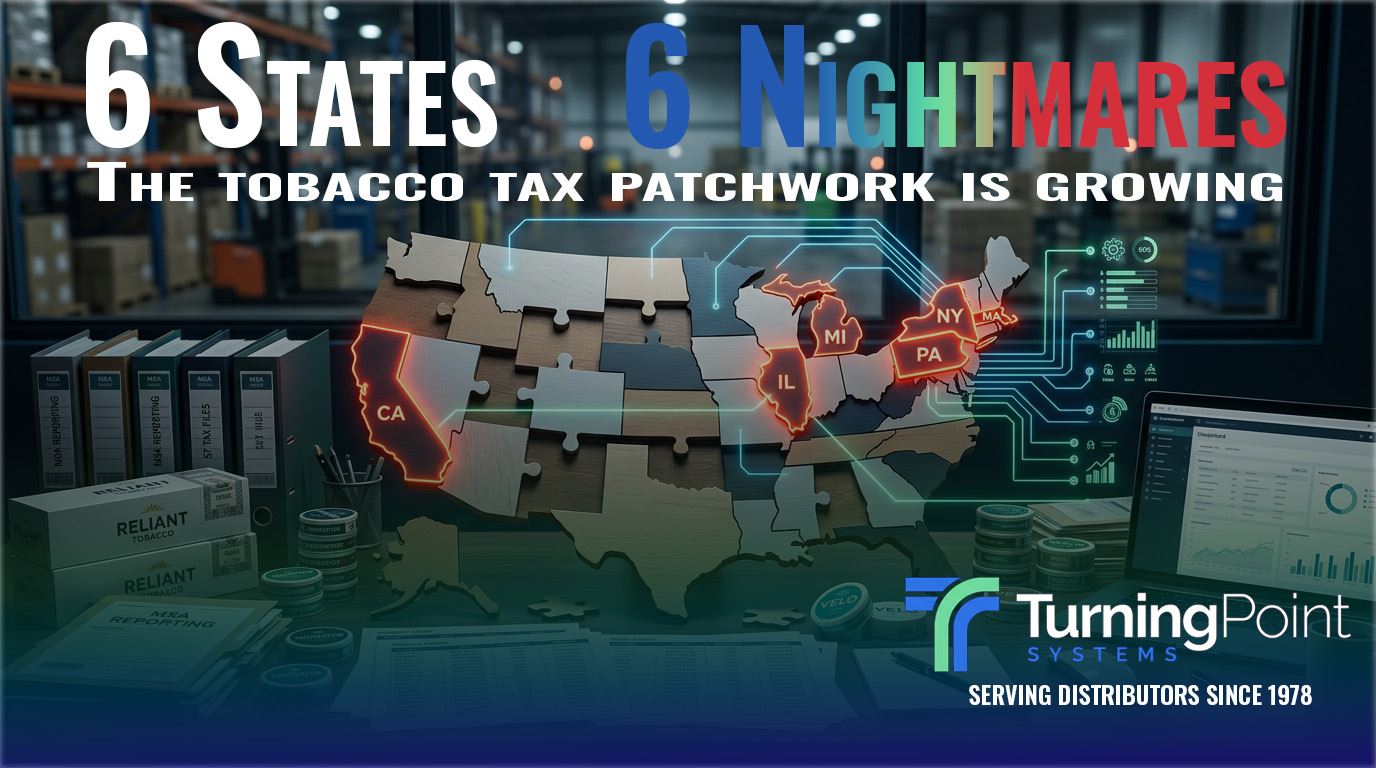
Here is what distributors are facing across six states right now. New York has proposed a 75 percent wholesale tax on nicotine pouches, with sub-jobber cigarette margins capped at 3 percent. Indiana raised its cigarette tax by more than 200 percent, from $0.995 to $2.99 per pack. Illinois started taxing nicotine pouches at 45 percent of wholesale for the first time. Maine increased its cigarette tax from $2.00 to $3.50. Washington state applies a 95 percent tax to all nicotine products. Rhode Island added nicotine pouches to other tobacco products at 80 percent wholesale tax.
Why Your Current System Cannot Handle This
At least 20 states introduced nicotine pouch tax bills in 2025 alone. The compliance patchwork is getting more complex, not simpler. If your system was built ten years ago, it probably handles basic cigarette tax calculation and maybe MSA reporting. But does it handle nicotine pouch excise taxes? State-specific OTP wholesale tax rates that change every legislative session? Automated MSA file generation in MultiCat format? Category-based quarterly reporting that breaks sales into cigarettes, tobacco, taxable, non-taxable, and beverage by customer?
When you are doing $18 million, you can afford to hire someone to manually reconcile tax reporting in Excel. When you are doing $10 million with a two-person office, that compliance work either gets done by the owner at 9 PM or it does not get done right. Neither option is sustainable.
Why Industry-Specific Distribution Software Changes Everything
An industry-specific ERP handles tobacco compliance natively because it was built for tobacco distributors, not adapted from a generic inventory platform. MSA reporting fields — UPC, stick count, tobacco code, report type — are built into product setup. Tax calculation is category-based and configurable by state. Reporting generates the file formats that MSA and state agencies require. TurningPoint Systems maintains a direct working relationship with Management Science Associates (MSAi) in Tarentum, PA — the organization that processes MSA data for the industry. That relationship ensures our compliance reporting stays current as requirements change.
What used to take 90 minutes of manual reconciliation takes five minutes with the right system. For the distributor in reset mode, every hour saved on compliance is an hour available for selling, delivering, or planning. Those hours compound.
Download the reset
Don't let manual reporting slow down your distribution growth. Access our expert guides.
See how real distributors scaled their operations and cut overhead costs.
Get the exact same powerful tobacco compliance engine as a standalone utility.
Generate exact, compliant state-by-state reports for products.