Why Waste Does Not Shrink When Revenue Does
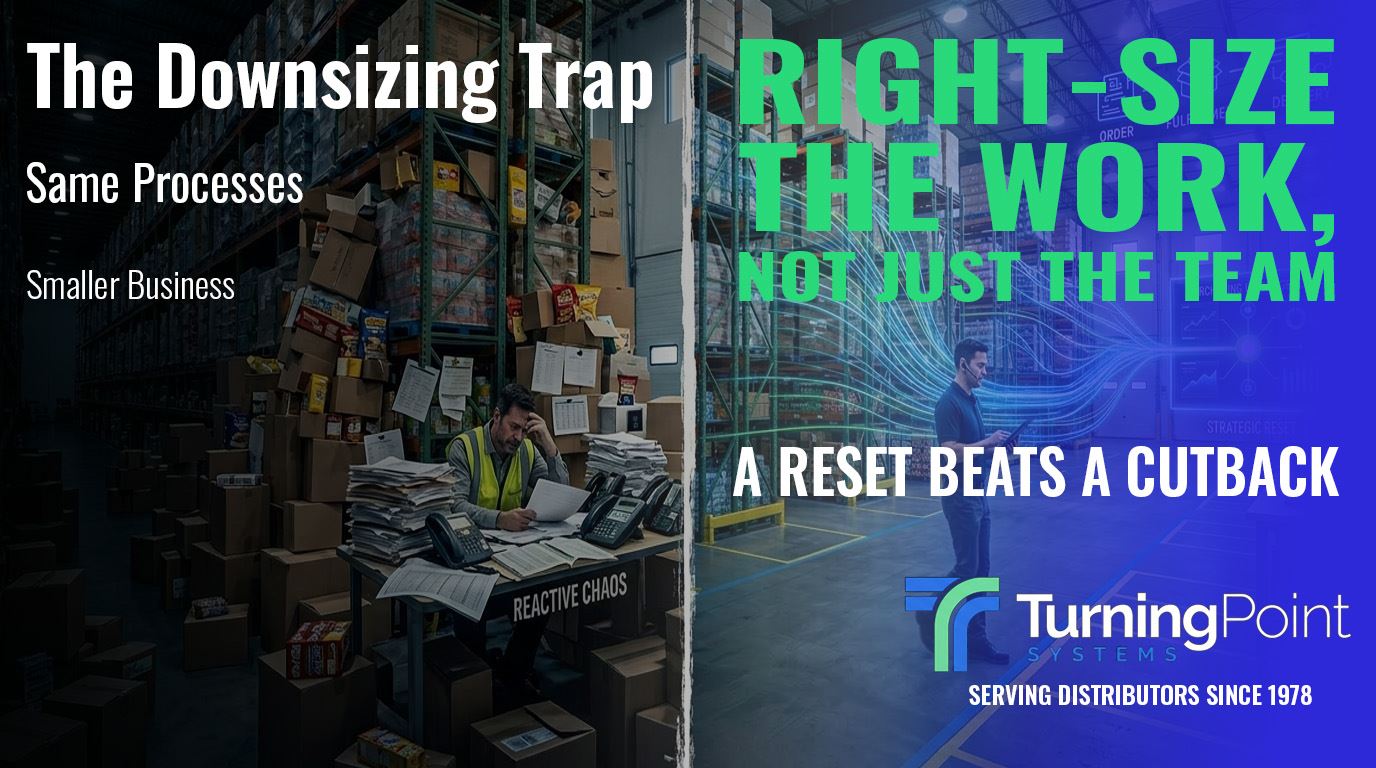
Here is the most common mistake we see distributors make during a contraction: they downsize by subtraction. Revenue drops from $18 million to $10 million, so they lay off a couple of people, stop taking as many deliveries, move into a smaller space, and keep running the same processes at lower volume.
The thinking is logical — less business, less everything. But waste does not shrink proportionally. As a percentage of revenue, it gets worse.
Consider what happens when revenue drops but processes stay the same. Your SKU count is still 2,000, but many items barely move — dead inventory taking up space in a smaller warehouse. Phone orders drop from 60 to 35 per day, but you still need someone answering phones, so labor cost per order goes up. Your 2 percent pick error rate is the same, but each error is more costly as a percentage of revenue. Delivery routes shrink from 8 to 5, but driver cost per delivery increases. Manual purchasing ties up a larger share of working capital. And compliance reporting requirements do not shrink with revenue — same hours, smaller business.
The Difference Between a Cutback and a Reset
A cutback is reactive — less of everything. You lay off people and hope the remaining staff covers the gaps. You move to a smaller space and squeeze the same 2,000 SKUs into it. You keep the same system and just run it less.
A reset is strategic — the right things done better. You right-size the team and give them tools that multiply their output. You move to a smaller space with a curated, data-driven SKU list. You deploy distribution software that automates what people used to do manually. You let customers order through a portal so you do not need phone lines. You get purchasing intelligence that tells you what to buy and when.
The Truck Analogy
Downsizing without modernizing is like buying a smaller truck that still gets 10 miles per gallon. At $18 million in revenue, fuel is an annoyance. At $10 million, that same truck’s fuel consumption is eating your profit. You do not need a smaller truck. You need a truck that gets 30 miles per gallon.
Download the reset
Don't let manual reporting slow down your distribution growth. Access our expert guides.