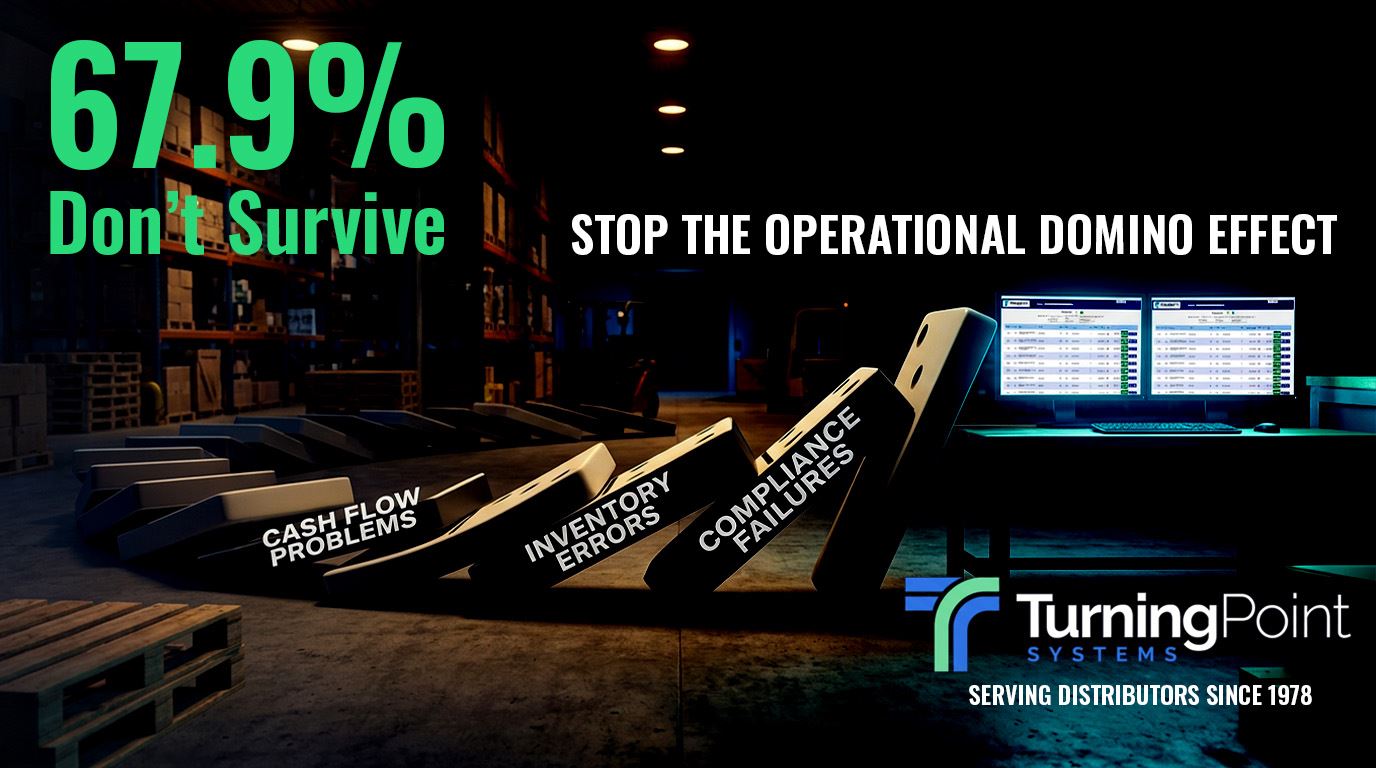
If you run a small wholesale distribution business, there is one number that should change how you think about every operational decision: 67.9%. That is the percentage of wholesale trade businesses started in 2013 that were gone by 2023, according to the Bureau of Labor Statistics. Nearly seven out of ten. That makes wholesale distribution the third-worst sector in America for long-term survival — and if your operation still depends on manual systems, the odds are working against you.
The question is not whether you need a wholesale distribution ERP system. The question is whether you can afford to keep running without one.
What Actually Kills Wholesale Distributors
The causes of failure are not mysterious. They cluster around operational gaps that compound over time. Poor cash flow management is cited by 82% of failed businesses. Average inventory accuracy across all businesses is just 83%, with 58% operating below 80% — meaning hundreds of thousands of dollars in stock is miscounted, misplaced, or missing. Compliance failures end tobacco distributors outright: inaccurate MSA data can cost you your direct purchasing status with manufacturers.
These are not market problems. They are operational problems. And every one of them has a technology solution that costs a fraction of what the failure itself costs.
The Evidence for Distribution Management Software
The data on what happens when distributors invest in technology is equally clear. Cloud ERP for wholesale distributors delivers an average ROI of 150–300%, with payback periods of one to three years. Cloud deployments specifically return 4x the ROI of on-premise systems and recover costs 2.5x faster.
The specific gains documented across industry research are striking: 10–25% inventory reduction, 80–85% reduction in order processing costs, and 30–50% reduction in manual tasks. Among small businesses classified as high-adoption by the U.S. Chamber of Commerce, 89% saw sales growth and 88% experienced profit growth. Among low-adoption businesses, only 33% could say the same.
Industry-specific distribution management software further improves outcomes. Organizations using industry-specific ERP are 32% more likely to integrate successfully, and 84% report achieving expected compliance benefits. For tobacco distributors, that compliance benefit is not theoretical — it is the difference between maintaining and losing your ability to purchase product.
What This Means for Your Operation
The 30.1% of wholesale distributors who survived a full decade are not simply luckier. They are operationally different. They invested in systems that give them real-time inventory visibility, automated compliance reporting, and the ability to scale without proportionally adding headcount. They made the decision while there was still time to make it.
TurningPoint Systems has served convenience wholesale distributors for 47 years. QwikPoint ERP serves distributors from $5M to $250M+ in annual revenue, with typical implementations completed in 6–8 weeks and documented ROI of 500–700%.
Download the full guide
Don't let manual reporting slow down your distribution growth. Access our expert guides.