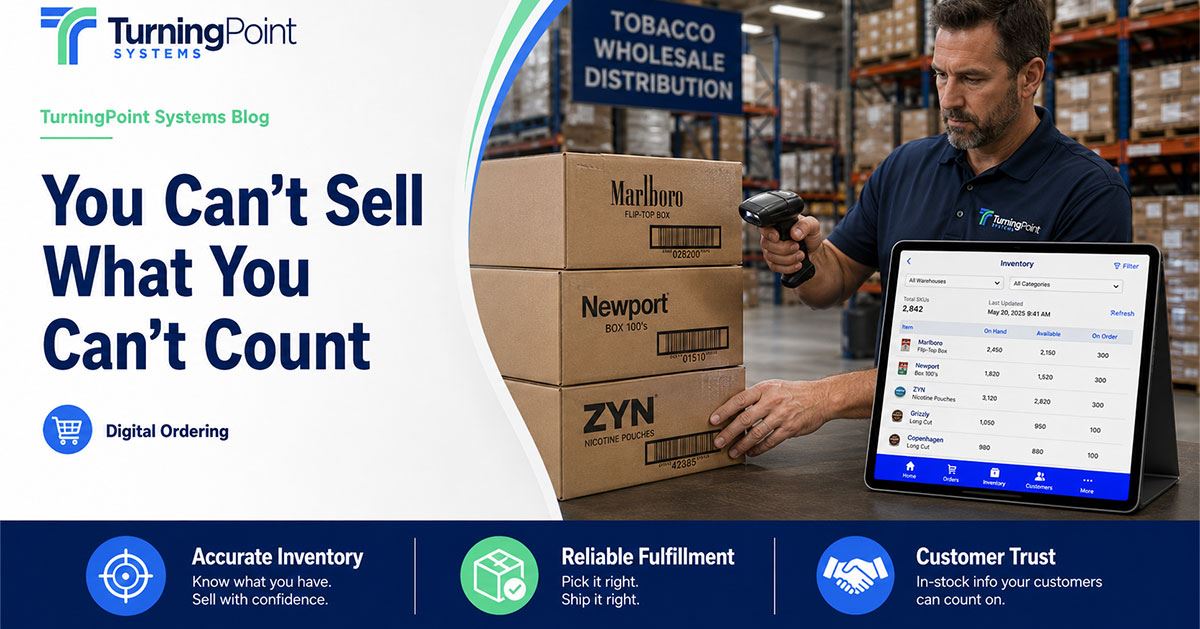
A digital ordering portal is only as honest as the inventory behind it. The moment a customer can place their own order, your inventory record stops being an internal number and becomes a customer-facing promise.
So when the count is wrong, the portal does not just underperform — it backfires. The customer orders what your screen says is in stock, and it isn’t. Now you are shorting the delivery, canceling a line, or shipping the wrong item — automatically, at scale, with no one there to soften it. The very thing that makes self-service powerful, the live catalog, turns on you the moment the inventory underneath it is off.
And for most distributors, it is off. Industry benchmarks put average store-level inventory accuracy around 65% (Auburn University RFID Lab). One broad study found average accuracy near 83% — but only about 69% of operations track it at all, and more than half run below 80%. Buyers are unforgiving when stock is wrong: studies of out-of-stock behavior find roughly 91% of shoppers won’t wait, and over 40% will go to a competitor.
The order of operations
Digital ordering works only when the layers underneath it are solid, in this order:
- Accurate inventory — the system knows what is really on the shelf.
- Reliable fulfillment — the right items go out, the first time.
- Customer trust — buyers believe the portal, so they actually use it.
- The revenue multiplier — bigger baskets, after-hours orders, freed-up reps.
Skip the first block and every block above it wobbles. This is also why the distributors who struggle to get customers onto a portal almost always have an accuracy problem underneath — the buyers tried it, got burned once, and went back to the phone.
The good news: accuracy is fixable, and faster than most owners expect. With scan-verified picking on one live system, distributors have moved from roughly one error in 50 orders to about one in 10,000; another cut daily picking errors to near zero. Fix the foundation first, and everything built on top of it finally holds.
Common Questions
Ready to scale your distribution? Find all the answers here
Why does inventory accuracy matter for a customer ordering portal?
expand_more
Because a self-service portal shows customers your live stock as a promise. If the count is wrong, they order what is not really there — and you short the delivery or ship the wrong item automatically, at scale. Accurate inventory is the foundation the whole portal sits on.
What is a good inventory accuracy rate for a wholesale distributor?
expand_more
World-class operations run above 95% real-time accuracy. Industry benchmarks put many distributors far lower — average store-level accuracy near 65%, with more than half below 80%. Scan-verified picking on one live system is how distributors close that gap.
Download the Full Guide
Don't let manual reporting slow down your distribution growth. Access our expert guides.