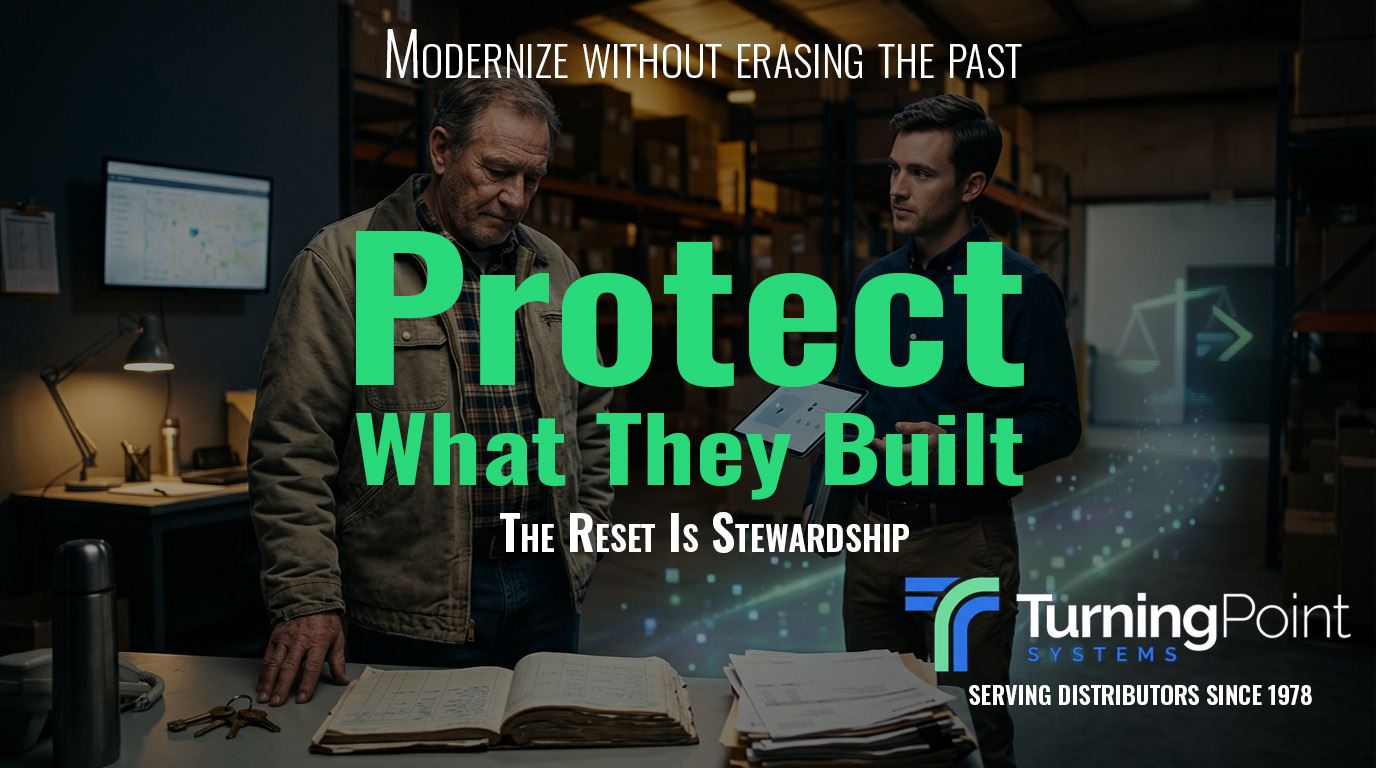
When the Business Is Contracting, Every Investment Feels Different
When your distribution business is growing, a technology investment feels like a growth bet. The family can frame it as building toward something bigger. The emotional register is optimistic.
When the business is contracting, the same investment triggers a completely different set of emotions. Revenue decline can feel like personal failure — even when the data proves it is market-driven. When you are spending family money, not bank money or investor capital, the threshold for any new expense is higher. And when the community sees that your business is smaller than it used to be, the stakes of a visible investment decision extend beyond the balance sheet.
The Family Dynamics Nobody Talks About
Convenience wholesale distribution in the United States is dominated by family-owned businesses. When you propose new technology to the person who built the business through instinct and 16-hour days, you are implicitly suggesting their methods are insufficient — at exactly the moment when they feel most vulnerable.
The founder who built a twenty-million-dollar distribution business from a single truck may not formally oppose the investment. He may simply express skepticism repeatedly until the proposal dies of its own weight. If your father or uncle or business partner keeps saying “not right now,” it is not necessarily about the money. It is about what the investment symbolizes during a period of decline.
Research on technology adoption in family-oriented business cultures has documented a critical finding: people adopt technology because trusted peers have already adopted it. A single phone call from a respected operator in the community who says “it worked for us” carries more weight than any white paper, any ROI analysis, any feature comparison.
The Reframe That Changes the Conversation
Investing during a contraction is not admitting failure. It is protecting what the family built. The reset is not a verdict on anyone’s methods — those methods built something real. What the family needs now is a system that preserves the core of what was built while making it sustainable at a different scale. That is not criticism. That is stewardship.
The math behind the investment has not changed: $53,000 to $102,000 per year in manual operations waste versus a $7,020 annual investment. A 7 to 14 times return. But the most powerful sales tool is not an ROI analysis. It is a phone call from a peer who says it worked.
Download the reset
Don't let manual reporting slow down your distribution growth. Access our expert guides.